

Researching Operation Paperclip
Can modern tools shed light on history?

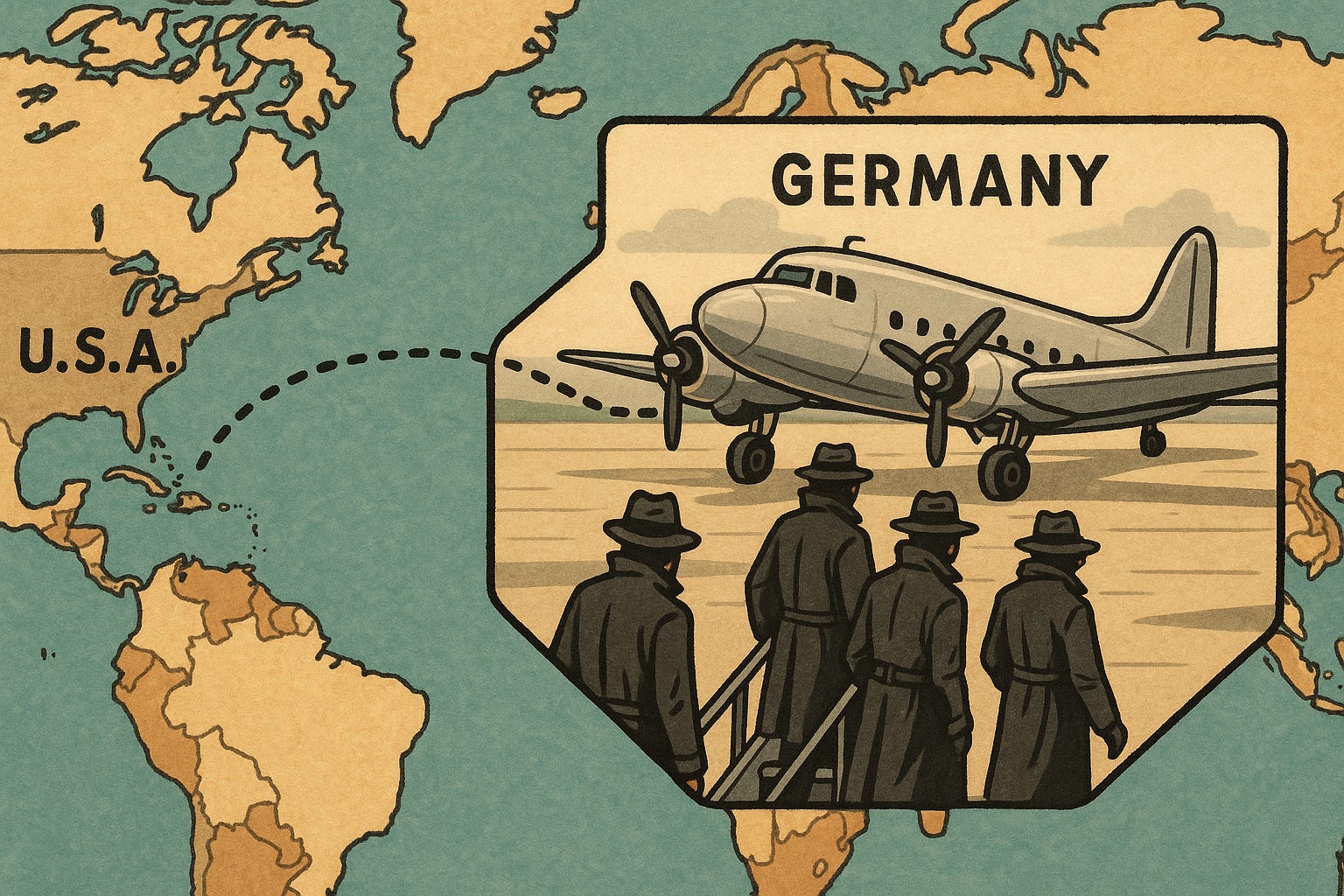
Studying history can involve a lot more than reading history books. This is the first in what could eventually be a series of posts in which I look at other, usually deeper, ways to develop historical knowledge. Not being a professional historian myself, this is a way of learning more about the field and sharing what I learn.
One of the more interesting and unusual things to come about with the end of the second world war was Operation Paperclip. This was a secret operation by the United States government to exfiltrate German scientists, engineers and technicians out of Germany and to the US, where their specialized knowledge could be put to use on this country's behalf. It was secret because many of the people being brought to the US were members of the Nazi party and often involved in what we now consider to be war crimes.
Wernher von Braun (Who I wrote about previously in A Tale of Two Titans) was one such Nazi war criminal who was brought here for his expertise in rocketry. He was instrumental in the Apollo program that put Americans on the Moon. Bringing him and as many as 1,600 others over from Germany took years and may have involved bribery, deceit, forged papers and more skulduggery than is yet completely known.
Recently, a new tool called "Google Gemini Deep Research" became available and I decided to take it for a spin to consider the question of how much (or little) is yet known about Operation Paperclip. The results were interesting.
The Problem
It all started when I saw this headline: Argentina announces declassification of documents on Nazis who fled to the country. Interesting! It's so well known that many Nazis escaped from Germany to Argentina after the war that it almost qualifies as an urban legend. The plan to release documents about it is exciting!
My mind somehow made the connection between this escape route and Operation Paperclip and I wondered how much of those records have been declassified. I turned to Gemini Deep research (GDR) to answer the question.
Genesis Deep Research
Genesis is an AI system of the Large Language Model type. It's very much like ChatGPT with both similar capabilities and similar weaknesses. Genesis Deep Research is a new variant of this that has extra features that allow it to not just answer questions but to search for the answers. The teaser says, "Save hours of work with Deep Research as your personal research assistant ..."
The thing that makes Deep Research different from ChatGPT is that it uses what's called an agentic approach. In other words, rather than just answering questions, it divides requests up into multiple steps and works through them one at a time. One task might be to search the web for information. Another task might be to evaluate the information returned by the search and look for information or ideas to follow up on. Another task could be to send an email about the findings. Many people are finding this approach to AI problem solving to be very powerful.
The Question
The instructions or questions you give to an AI are called the prompt. To kick off this research, I gave GDR the following prompt:
I know that at least some documents related to Operation Paperclip were released a while back. But I've heard that at least some of them were redacted. How much has really been released? Where would I find it? Is there a schedule for more to be released?
I was pleasantly surprised when the first thing GDR did was show me a research plan. Mostly, it consisted of "search for relevant information about (something)." Okay. It would have taken me more than the minute (or less) it took GDR to come up with that plan. Much more. GDR offered me the chance to edit the plan, which I declined to do. Maybe with more experience with the tool I might try that. Instead, I clicked the button to execute the plan.
It took a few minutes for GDR to do its research. When it was done it prepared a report on its findings, complete with references. It started with a summary of what Operation Paperclip was. This was exactly the kind of summary that AIs are famous for. It was moderately well written, moderately informative and completely unnecessary. If I hadn't already known what Operation Paperclip was, I wouldn't have even known to ask the questions.
I suppose one must make allowances for new technology.
The summary was short and followed up with something more responsive to my questions. The meat of it was this: "The declassification and release of documents pertaining to Operation Paperclip have been significantly influenced by legislative actions, most notably the Nazi War Crimes Disclosure Act of 1998."
This is worthwhile information. As an added bonus, I didn't find it on the Wikipedia page on Operation Paperclip. That's probably where I would have started if I hadn’t been using GDR so it scores some points there.
But then there's this bit: "the IWG [Interagency Working Group] has overseen the declassification of an impressive total of over 8 million records pertaining to Nazi war crimes. Although not all of these documents explicitly reference Operation Paperclip by name, it is highly probable that a significant portion of this vast collection contains information relevant to the program, given its close connection to the broader context of post-war interactions with individuals associated with Nazi Germany."
In other words, Operation Paperclip documents are likely to be mixed in with other documents related to Nazi War Crimes. GDR offered no advice on separating one from the other.
I asked for numbers and there were a few in the report.
"In 2002, for instance, the IWG's work led to the declassification of 97 key documents directly related to Operation Paperclip."
"Approximately 27,000 pages of CIA records detailing the agency's operational relationships with former Nazis in the aftermath of World War II have been disclosed."
"The National Archives and Records Administration (NARA) serves as a central repository for many of these declassified documents. Notably, NARA holds over 1,500 personnel dossiers on German and other foreign scientists who were brought to the United States under the auspices of Project Paperclip and similar programs."
"Considering the various releases from different agencies and the holdings at the National Archives, it can be reasonably estimated that the total volume of released documentation related to Operation Paperclip and its broader historical context amounts to hundreds of thousands, if not millions, of pages."
The sheer volume of documents might explain why there were few specifics but it's important to remember that generic summaries are the default mode for current AIs.
The next section of the report was about finding documents to work with. This was valuable. It said that most docs are within the National Archives, which is a vast and constantly growing collection of documents that I quickly found is not user friendly. At all! There's a frustrating ambiguity, in the references, too. For example, "Record Group 263 encompasses the records of the Central Intelligence Agency (CIA) and includes both subject files and name files pertaining to Nazi war crimes. These files may contain valuable information about individuals involved in Operation Paperclip."
May contain? It appears that the law that mandated declassification of the kinds of documents I asked about also made it difficult to distinguish between the different categories. Or maybe the problem is that the nature of Operation Paperclip necessarily overlapped with Nazi war crimes. The Nazis made heavy use of technical and scientific experts. They also made heavy use of slave labor as well as drawing human test subjects from the camps. They never even considered the idea of "informed consent."
This is why Operation Paperclip was, and still is, controversial. The people brought over here were not moral giants who stood up to Nazi evil. Nor were they hapless bystanders. To the contrary, they were often Nazis themselves. The US government helped them escape the consequences of their crimes because it was hoped they would be useful.
To be fair(ish), many of them were very useful to the US. The controversy is about whether that fact could excuse helping them evade justice.
More to the point of what I was looking for is a mention (and link) to "Record Group 330, which comprises the Records of the Secretary of Defense.[10, 14] This record group includes the "Foreign Scientist Case Files, 1945-1958," a collection that contains personnel dossiers on over 1,500 German and other foreign scientists who were brought to the United States under Project Paperclip and related initiatives."
Really, it could have led with this!
The next section of the report considered redactions, which I had specifically asked about. In my own very brief sampling of documents in the National Archives, I found that there were frequent redactions. They seemed to focus on the names of bureaucrats who authored documents or passed decisions along the chain. Those don’t seem very important. But, is there more?
GDR answered that question with this tidbit: "The extent and nature of redactions can vary significantly from document to document and across different agencies." In other words, it didn't even come close to answering the question.
Analysis
I had three basic criteria for evaluating Gemini Deep Research.
Did it answer my questions?
Did it save me time over doing the research myself?
Did I learn useful things while using it?
The answers to all three questions were the same. "Yes, but ..."
I've already mentioned that the answers were summaries. They avoided clear and precise details, going instead for generalizations. When I asked how much documentation had been released about Operation Paperclip, I was hoping to see something like, "84% of all known documents, for a total of 2,142,300 documents out of more than 3 million."
Likewise, when I asked how much was redacted I wanted something like, "Most documents released contain minor redactions of names of people who are not the actual subjects of those documents. However, up to 15% of released documents contained major redactions of as much as 80% of content."
No such clarity was available.
The answer to the second question (about saving time) is much more concrete. GDR probably saved me a few dozen hours. That's what I think it would take to get up to speed on the extent of documentation and what has been released. But that was all it did. It helped me come up to speed. The "Deep" in Deep Research was absent.
To give an illustration, in another conversation I asked it to give more names of people brought over in OP beyond the few in the original report. It gave me many more names, that it drew from a Wikipedia page containing them1.
I could have done that myself.
As for the last question, yes, I did learn some things about the operation, including a tantalizing hint of other, similar programs, after Operation Paperclip. However, it doesn't list them. Would have been nice.
Conclusion
Operation Paperclip is a fascinating aspect of history. What if it had never happened? How would the current technological landscape be different? Would the Soviet Union have gained a decisive advantage in the Cold War? Or would it have mattered in the long run?
The urge to research it more deeply was a whim that happened to coincide with the chance to try out a new research tool. The tool turned out to be useful but mostly as a way of getting started with a topic. It is not at all useful for doing "deep" research. The quality of the reports it delivered was about on a par with what could be expected from a moderately industrious undergrad student. In fact, I think that's probably the target audience2.
Still, it gave me some links I can use to explore Operation Paperclip more deeply. Now I just need to find the time to follow them.
Reports
Here are the two reports I got from GDR on Operation Paperclip documentation.
https://docs.google.com/document/d/1r4hqasbSPZnPCHBOqXHRd2SnE827vZ-V4SqMivwrcWA/edit?usp=sharing
https://docs.google.com/document/d/1qaLe2t-hPqt9zdJhJgMVMMcqi7jTWYS2M5wfn0GEn0M/edit?usp=sharing
Here's that prompt: "I would like an image of a world map with the US and Germany. A bit of Germany is pulled out and enhanced to show an old fashioned propeller driven plane at an airport. People wearing trench coats with dark hats pulled low, partly obscuring their faces, are boarding the plane. A dotted line goes from the airport in Germany to the US. The image is not at all to scale and is somewhat cartoonish."
Notice that the dotted line doesn't really go to the US. It seems to be going closer to Cuba. I asked ChatGPT to change that and it tried again. The second try, the line still went to Cuba but now Germany was spelled "Uerman." I decided to quit while I was ahead and use the first image.
List of Germans relocated to the US via the Operation Paperclip. I found this page at the top of the Google results for "list of operation paperclip scientists."
Professors take note.